What is an IU on a vitamin label (and why you can't convert IU to mg with one number)
Search "4000 IU in mg" and you'll find three different answers. They're all correct, just for different vitamins. An IU measures what a dose does, not what it weighs, so vitamins A, D and E each have their own factor, and A and E have a different one for each form.
An IU (international unit) tells you how strongly a dose acts in the body, not how much it weighs. So 1 IU of vitamin D is 0.025 mcg, while 1 IU of natural vitamin E is 0.67 mg, 26,800 times heavier. For a quick answer, open the IU to mcg and mg converter. This page explains why it works the way it does and how to avoid mistakes on the label.
What IU means on a label
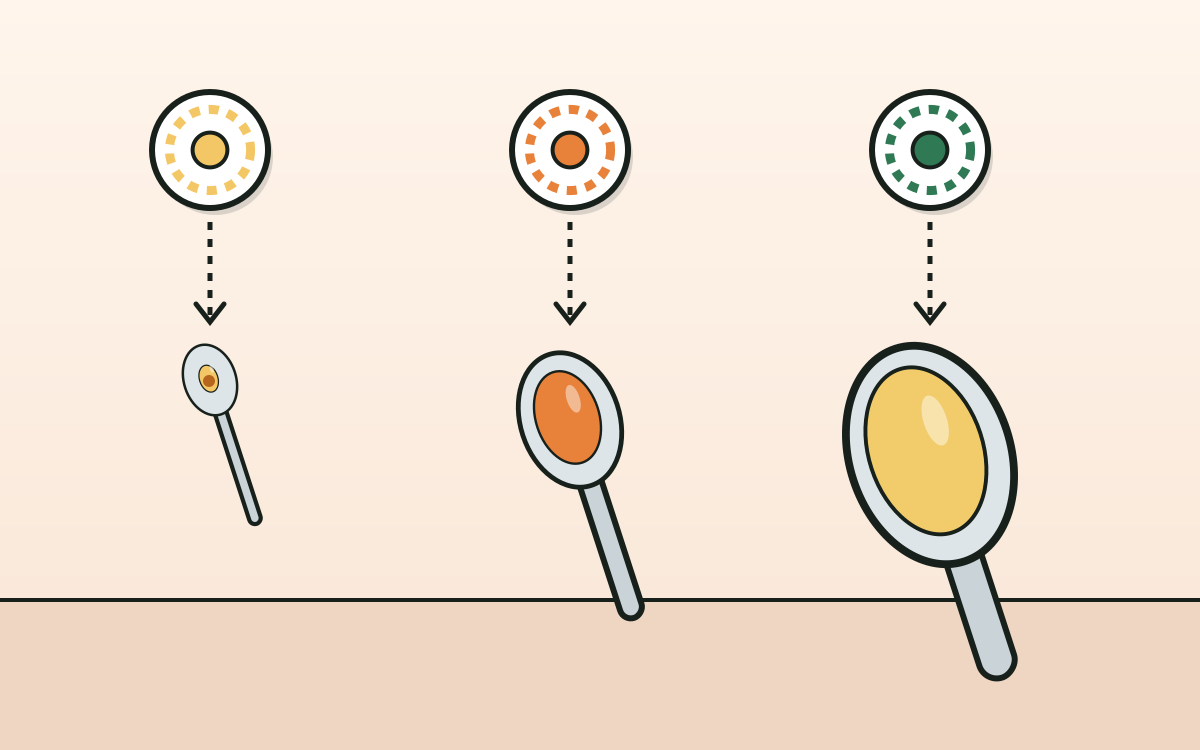
A milligram is a weight. An IU is an effect. When the molecules are identical, you don’t notice the difference: 1 mcg of vitamin D3 always gives 40 IU. But some vitamins come in forms that act more weakly or more strongly at the same weight.
Two examples from NIH ODS:
- synthetic vitamin E (dl-alpha-tocopherol) is a mix of eight similar molecules, and your body keeps only four, so the FDA counts 2 mg of it as 1 mg of vitamin E. The mg on the label show the part that counts, which is why 1 IU of synthetic gives 0.45 mg and 1 IU of natural gives 0.67 mg;
- beta-carotene from carrots gives you less vitamin A than beta-carotene in a capsule. From food, 1 IU is worth 0.05 mcg RAE; from a supplement, 0.3 mcg.

Which vitamins are measured in IU
On supplement labels you’ll meet IU for three vitamins:
- A – retinol (retinyl palmitate, retinyl acetate) and beta-carotene;
- D – D3 (cholecalciferol) and D2 (ergocalciferol), which share one factor;
- E – natural d-alpha-tocopherol and synthetic dl-alpha, plus their esters (acetate, succinate).
B vitamins, vitamins C and K and minerals are given in mg or mcg, so there’s nothing to convert.
IU to mg: the factor for each vitamin
| Vitamin and form | 1 IU | 1,000 IU | 4,000 IU |
|---|---|---|---|
| D (D3 and D2) | 0.025 mcg | 25 mcg (0.025 mg) | 100 mcg (0.1 mg) |
| A, retinol | 0.3 mcg RAE | 300 mcg RAE (0.3 mg) | 1,200 mcg RAE (1.2 mg) |
| A, beta-carotene from supplements | 0.3 mcg RAE | 300 mcg RAE | 1,200 mcg RAE |
| A, beta-carotene from food | 0.05 mcg RAE | 50 mcg RAE | 200 mcg RAE |
| E, natural (d-alpha) | 0.67 mg | 670 mg | 2,680 mg |
| E, synthetic (dl-alpha) | 0.45 mg | 450 mg | 1,800 mg |
For beta-carotene, mcg RAE (retinol activity equivalents) isn’t the weight of the carotene itself but how much retinol your body gets from it. Vitamin A has its own page: vitamins A and E.

4,000 IU in mg
Most people asking this mean vitamin D. 4,000 IU of vitamin D is 100 mcg, or 0.1 mg, and that’s the adult upper limit set by EFSA and the NHS. The full chart from 2.5 to 250 mcg, with children’s limits, is on vitamin D mcg to IU.
For retinol, 4,000 IU is 1,200 mcg RAE (1.2 mg). For vitamin E the number gets silly: 2,680 mg of the natural form, almost nine times EFSA’s 300 mg limit. Read the label again, because it may well say 400 IU. Vitamin E conversions are covered in detail in vitamin E IU to mg.
1 IU and 10 IU in mg
Small numbers cause the most confusion:
- vitamin D: 1 IU is 0.025 mcg, and 10 IU is 0.25 mcg (0.00025 mg), forty times less than the 10 mcg the NHS advises each day;
- vitamin E: 10 IU is 6.7 mg of the natural form or 4.5 mg of the synthetic form;
- retinol: 10 IU is 3 mcg RAE.
Why labels now use mcg and mg
In the US, the new Supplement Facts labels became mandatory in January 2020, and in January 2021 for companies with annual sales under $10 million. Vitamin D now appears in mcg, and the FDA allows IU in brackets alongside. Vitamin A is in mcg RAE and vitamin E in mg. An FDA guidance document from 2019 shows manufacturers how to convert the old IU, using the same factors as the table above.
UK and EU labels give vitamins in µg and mg with a % NRV, and the NHS gives its vitamin D advice in micrograms. Older articles, forum posts and the front of many bottles still talk in IU. So a bottle from iHerb saying “25 mcg (1,000 IU)” and a friend’s advice to take “1,000 IU” mean exactly the same dose.
How to read IU on an iHerb label
- Ignore the front of the bottle and go to the Supplement Facts panel.
- Find the unit: mcg, mcg RAE or mg. IU in brackets is a hint, not the main figure.
- Read the form after “as” in the brackets: cholecalciferol, retinyl palmitate, d-alpha tocopheryl succinate.
- If you need IU, use the factor for that exact form.
- Add up the same vitamin across every bottle you take.
Where the label shows IU and where it shows mg
A sample Supplement Facts panel. Tap a line
Supplement Facts
How to read it
IU in big letters
A vitamin E bottle often still shows IU on the front. It doesn't name the form, so that number alone isn't enough to convert.
How to read it
Serving size
Every number below is per softgel. If a serving is two and you take one, halve the figures.
How to read it
Amount and % DV
% DV uses US daily values: 900 mcg RAE for vitamin A, 20 mcg for D and 15 mg for E. UK labels use % NRV instead.
How to read it
Vitamin A in mcg RAE
Retinyl palmitate is preformed retinol. 900 mcg RAE is 3,000 IU: divide by 0.3. An older label would have said 3,000 IU.
How to read it
Vitamin D: mcg, with IU in brackets
The FDA requires vitamin D in mcg and allows IU in brackets as an option. 25 mcg × 40 = 1,000 IU.
How to read it
Vitamin E in mg
This is the 400 IU from the front. d-alpha is the natural form, so 400 × 0.67 = 268 mg. With dl-alpha it would be 180 mg.
Where people trip up on the label:
- seeing “400 IU” on two vitamin E bottles and assuming the doses match. With d-alpha it’s 268 mg, with dl-alpha 180 mg;
- thinking “1,000 IU” from a friend and “25 mcg” on the bottle are different doses, and buying a second bottle to be safe;
- reading % DV as a limit. It’s a share of the US daily value, and 125% for vitamin D is still well within the limit;
- treating % DV on a US bottle and % NRV on a UK or EU pack as the same thing, when the reference amounts differ.
Slips in the maths itself, such as dividing vitamin E by 40, are listed on the IU converter page.
The rest of the panel is explained in how to read a supplement label, and vitamin D doses and forms in how much vitamin D3 to take.
FAQ
What is an IU in vitamins?
An IU (international unit) measures a substance’s biological activity rather than its mass. Supplement labels use it for vitamins A, D and E. How much 1 IU weighs depends on the vitamin and its form.
How much is 1 IU in mg?
It depends. 1 IU of vitamin D is 0.000025 mg (0.025 mcg), of retinol 0.3 mcg RAE, of natural vitamin E 0.67 mg and of synthetic vitamin E 0.45 mg.
How do I convert IU to mg?
Work out which vitamin and which form you have, then multiply the IU by that form’s factor. For vitamin D, multiply by 0.025 to get mcg; for natural vitamin E, multiply by 0.67 to get mg. Our converter does it for you.
What is 4,000 IU in mg?
For vitamin D, 0.1 mg (100 mcg), which is the adult upper limit in the UK and EU. For retinol, 1.2 mg (1,200 mcg RAE). For vitamin E, 2,680 mg natural or 1,800 mg synthetic, far above EFSA’s 300 mg limit.
Is IU the same as mg or mcg?
No. mg and mcg are weights; an IU is a unit of activity. That’s why US labels now give vitamin D in mcg, vitamin A in mcg RAE and vitamin E in mg, with IU in brackets as an optional extra for vitamin D.
Sources
- NHS. Vitamins and minerals – Vitamin D
- NIH ODS. Vitamin D – Fact Sheet for Health Professionals
- NIH ODS. Vitamin E – Fact Sheet for Health Professionals
- NIH ODS. Vitamin A and Carotenoids – Fact Sheet for Health Professionals
- FDA (2019). Converting Units of Measure for Folate, Niacin, and Vitamins A, D, and E on the Nutrition and Supplement Facts Labels
- EFSA. Summary of Tolerable Upper Intake Levels for vitamins and minerals
1 IU equals
From NIH ODS and the FDA
- Vitamin D (D3 and D2)
- 0.025 mcg
- Vitamin A, retinol
- 0.3 mcg RAE
- Beta-carotene, supplements
- 0.3 mcg RAE
- Natural vitamin E (d-alpha)
- 0.67 mg
- Synthetic vitamin E (dl-alpha)
- 0.45 mg
B vitamins, vitamin C and minerals are listed in mg or mcg.