IU to mcg and mg converter: vitamin D, A and E from the label
This article contains affiliate links to iHerb. If you buy through them, we earn a commission at no extra cost to you. It doesn't affect which forms we recommend. Learn more
One bottle lists vitamin D in IU, another in micrograms, and the NHS gives its advice in micrograms. This converter turns international units into mcg or mg using NIH ODS factors, and the table below answers the common questions without any maths.
How to use the converter
- Find the vitamin on the label and the number in IU.
- Pick the vitamin. For vitamin A, check the form: retinol (retinyl palmitate or acetate) or beta-carotene. For vitamin E, check whether it’s natural (d-alpha) or synthetic (dl-alpha).
- Enter the IU.
- The result shows the amount in mcg or mg, with the upper limit for reference.
Convert IU to mcg or mg
Pick the vitamin and enter the IU number from the label
25 mcg
The unit is in the line below: mcg for D and A, mg for E
1,000 IU = 25 mcg
1 mcg = 40 IU. The adult upper limit is 100 mcg (4,000 IU) a day; the NHS advises 10 mcg (400 IU).
Factors from NIH ODS. Beta-carotene from food and other carotenoids use different factors.
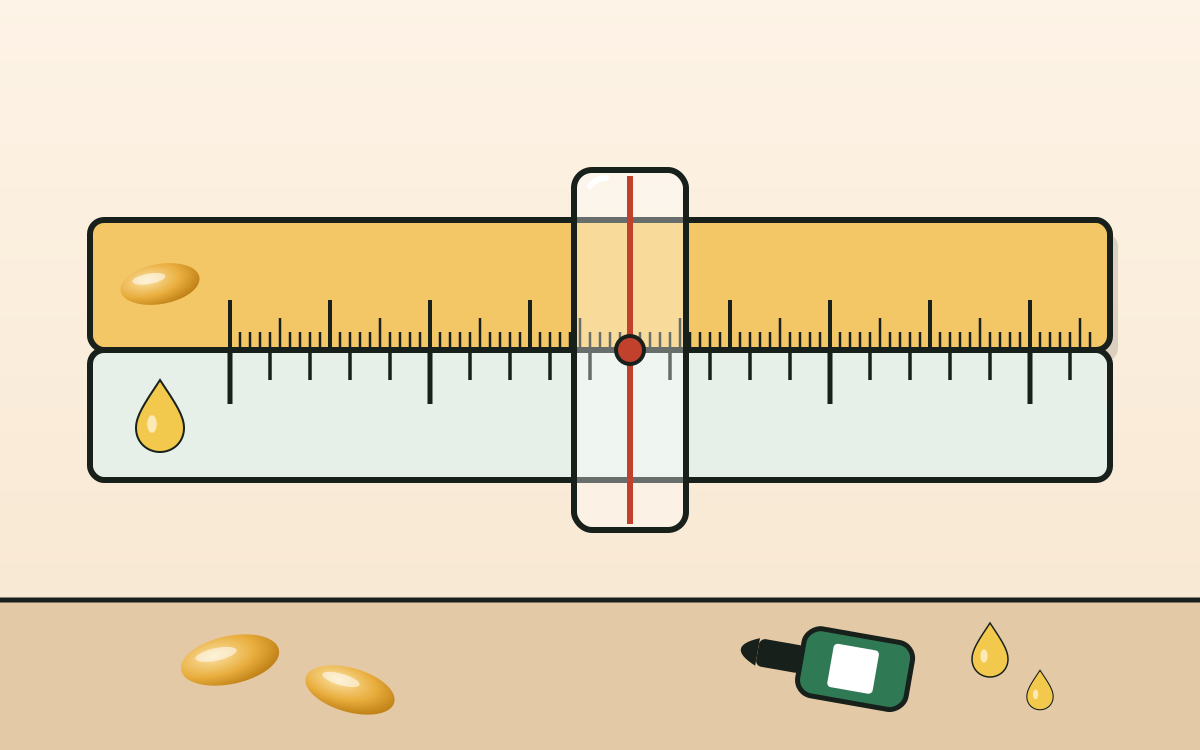
Why labels use IU instead of milligrams
An IU (international unit) measures biological activity, not weight. So 1 IU of vitamin D and 1 IU of vitamin E are completely different amounts of substance.
US labels have moved to mcg and mg. NIH ODS notes, for example, that vitamin E now appears in milligrams: the new Supplement Facts labels became mandatory in January 2020, and in January 2021 for smaller companies. Many bottles on iHerb still show both units, and older advice often uses IU only. In the UK, the NHS gives vitamin D advice in micrograms.
Vitamin D: IU to mcg
1 mcg of vitamin D = 40 IU, so 1 IU = 0.025 mcg. To convert IU to mcg, divide by 40. To convert mcg to IU, multiply by 40.
| Vitamin D, IU | Vitamin D, mcg | Comment |
|---|---|---|
| 400 | 10 | NHS advice for adults |
| 600 | 15 | US recommendation for adults up to 70 |
| 1,000 | 25 | a common maintenance dose |
| 2,000 | 50 | the top of the usual maintenance range |
| 4,000 | 100 | the adult upper limit |
| 5,000 | 125 | a popular iHerb strength, but above the limit: medical advice only |
Doses and forms are covered in how much vitamin D3 to take; our vitamin D test guide explains blood results.
Vitamin A: retinol and beta-carotene
Vitamin A is now listed in mcg RAE (retinol activity equivalents). This unit reflects that your body gets less vitamin A from carotenoids than from preformed retinol. NIH ODS factors:
- 1 IU retinol = 0.3 mcg RAE;
- 1 IU beta-carotene from supplements = 0.3 mcg RAE;
- 1 IU beta-carotene from food = 0.05 mcg RAE;
- 1 IU alpha-carotene or beta-cryptoxanthin = 0.025 mcg RAE.
The US upper limit for adults is 3,000 mcg RAE a day, and it applies only to preformed vitamin A (retinol). UK advice is stricter. According to the NHS, an average of 1.5 mg (1,500 mcg, or 5,000 IU of retinol) a day or less from food and supplements combined is unlikely to cause harm. Post-menopausal women and older men should stay within it for bone health. If you’re pregnant, could be pregnant or are breastfeeding, avoid high-dose vitamin A supplements above 3,000 mcg RAE (10,000 IU): too much retinol can cause birth defects. High-dose beta-carotene (20 mg a day) raised lung cancer risk in smokers in trials, so smokers should avoid it.
More in our guide to vitamins A and E.
Vitamin E: natural and synthetic
Vitamin E has two factors because the synthetic form is less active:
- natural (d-alpha-tocopherol, RRR): 1 IU = 0.67 mg, or 1 mg = 1.49 IU;
- synthetic (dl-alpha-tocopherol, all-rac): 1 IU = 0.45 mg, or 1 mg = 2.22 IU.
Adults need 15 mg of alpha-tocopherol a day by US figures. The US upper limit is 1,000 mg a day: that’s 1,500 IU of the natural form or 1,100 IU of the synthetic form. In the UK, the NHS sets a lower bar: 540 mg (800 IU) or less a day from supplements is unlikely to cause harm. The ingredients tell you which you have: “d-alpha tocopherol” is natural, “dl-alpha tocopherol” is synthetic.

Reference table: IU to mcg and mg
| Vitamin | 1 IU equals | Reverse | Adult upper limit |
|---|---|---|---|
| D | 0.025 mcg | 1 mcg = 40 IU | 100 mcg (4,000 IU) |
| A, retinol | 0.3 mcg RAE | 1 mcg RAE = 3.33 IU | 3,000 mcg RAE (US) |
| A, beta-carotene from supplements | 0.3 mcg RAE | 1 mcg RAE = 3.33 IU | the retinol limit doesn’t apply |
| E, d-alpha-tocopherol | 0.67 mg | 1 mg = 1.49 IU | 1,000 mg (1,500 IU) |
| E, dl-alpha-tocopherol | 0.45 mg | 1 mg = 2.22 IU | 1,000 mg (1,100 IU) |
These limits are US figures. NHS guidance is lower for vitamin A (1,500 mcg a day from all sources) and vitamin E (540 mg a day from supplements).
Not sure which row is yours? Pick the form as it’s written on the ingredients line:
What does your label say?
Pick the form named on the ingredients line to see its factor and limit
The label says
How to convert
Divide the IU by 40
1 mcg of vitamin D = 40 IU. So 400 IU is the NHS's 10 mcg, and 1,000 IU is 25 mcg.
Limit: 100 mcg (4,000 IU) a day for adults
5,000 IU (125 mcg) is above the limit: medical advice only.
How to convert
Retinol: 1 IU = 0.3 mcg RAE
This is preformed vitamin A, the form the upper limit covers. NHS advice is stricter: 1,500 mcg a day or less from food and supplements.
Limit: 3,000 mcg RAE a day (US)
Pregnant or breastfeeding: avoid high-dose supplements above 3,000 mcg RAE (10,000 IU).
How to convert
Beta-carotene from supplements: 1 IU = 0.3 mcg RAE
The retinol limit doesn't apply to beta-carotene.
20 mg a day raised lung cancer risk in smokers in trials.
How to convert
Natural vitamin E: 1 IU = 0.67 mg
Reverse: 1 mg = 1.49 IU. The NHS says 540 mg (800 IU) a day or less from supplements is unlikely to cause harm.
Limit: 1,000 mg (1,500 IU) a day (US)
How to convert
Synthetic vitamin E: 1 IU = 0.45 mg
The synthetic form is less active, so each IU weighs less. Reverse: 1 mg = 2.22 IU.
Limit: 1,000 mg (1,100 IU) a day (US)
How to convert
Check the units
1 mg = 1,000 mcg. "25 mg of vitamin D" instead of "25 mcg" is a thousandfold error.
Count per serving: check how many drops or capsules make one.
Common conversion mistakes
- Mixing up mg and mcg. 1 mg = 1,000 mcg, so “25 mg of vitamin D” instead of “25 mcg” is a thousandfold error.
- Dividing everything by 40. That factor only works for vitamin D; every other vitamin has its own.
- Holding beta-carotene to the retinol limit. The 3,000 mcg RAE limit covers preformed vitamin A only.
- Counting a single drop when the label gives the dose for a serving of several drops or capsules.
- Forgetting the multivitamin. It often contains D, A and E too, and they count towards the limit.
Who should be careful with high doses
Vitamins D, A and E are fat-soluble and build up in the body. Take vitamin D above 100 mcg (4,000 IU) or retinol above 3,000 mcg RAE only on medical advice. In pregnancy, don’t take retinol supplements without your midwife or GP. To check other combinations, use our vitamin compatibility chart.
How to choose on iHerb with this converter
- Convert the dose from IU to mcg or mg so you compare bottles in the same units.
- For vitamin D, compare the total from all supplements with the 100 mcg (4,000 IU) limit.
- With vitamin A, check the form: retinol or beta-carotene.
- For vitamin E, look for “d-alpha tocopherol” if you want the natural form.
- Check the rest of the panel with our guide on how to read a supplement label.
Bottom line: what to choose
Autumn and winter vitamin D
D3 10–25 mcg (400–1,000 IU)
With a meal that contains some fat
D3 on iHerbYou want vitamin E
Natural d-alpha-tocopherol
Look for "d-alpha" in the ingredients
Vitamin E on iHerbYou need vitamin A and are pregnant
Beta-carotene, not retinol
High-dose retinol is harmful in pregnancy
Beta-carotene on iHerbButtons lead to selections of the right form on iHerb. These are affiliate links; your price doesn't change.
FAQ
How many IU is 1 mcg of vitamin D?
40 IU. So 10 mcg = 400 IU, 25 mcg = 1,000 IU, 50 mcg = 2,000 IU and 100 mcg = 4,000 IU.
How do I convert vitamin D IU to mcg?
Divide the IU by 40. For example, 2,000 IU / 40 = 50 mcg, and 5,000 IU / 40 = 125 mcg.
Is there one IU to mg converter for all vitamins?
No. An IU measures biological activity, and each vitamin has its own factor. For vitamin D 1 IU = 0.025 mcg, for retinol 0.3 mcg, and for natural vitamin E 0.67 mg.
What's the difference between d-alpha and dl-alpha-tocopherol?
d-alpha-tocopherol is natural vitamin E; dl-alpha is synthetic. The synthetic form is less active, so 1 IU of dl-alpha equals 0.45 mg, while 1 IU of the natural form equals 0.67 mg of alpha-tocopherol.
What does mcg RAE mean for vitamin A?
RAE (retinol activity equivalents) reflects that beta-carotene and other carotenoids give your body less vitamin A than retinol does. That’s why current labels list vitamin A in mcg RAE.
Sources
Conversion factors
Based on NIH ODS
- Vitamin D
- 1 mcg = 40 IU; 1 IU = 0.025 mcg
- Vitamin A (retinol)
- 1 IU = 0.3 mcg RAE
- Beta-carotene, supplements
- 1 IU = 0.3 mcg RAE
- Natural vitamin E (d-)
- 1 IU = 0.67 mg
- Synthetic vitamin E (dl-)
- 1 IU = 0.45 mg
An IU measures activity, so every vitamin has its own factor.
Shop D3 on iHerb25 mcg = 1,000 IU