Ginkgo biloba: does it help memory, how to take it and who should avoid it
This article contains affiliate links to iHerb. If you buy through them, we earn a commission at no extra cost to you. It doesn't affect which forms we recommend. Learn more
Ginkgo biloba is one of the best-known supplements for memory. Two large trials in almost 6,000 older people found it didn't prevent dementia. You'll find the trial results, how to choose an extract and why ginkgo and blood thinners are a risky mix.
What is ginkgo biloba?
Ginkgo biloba is one of the oldest tree species on Earth, often called a “living fossil”. Supplements use an extract of its fan-shaped leaves. Its active compounds are thought to be flavonoids and terpene lactones, the ginkgolides and bilobalide.
The fruit and seeds are not used in supplements. Fresh ginkgo seeds are toxic when eaten, and serious poisoning has also followed roasted seeds.
Extracts vary a lot. The European Pharmacopoeia describes a refined, standardised leaf extract with:
- 22–27% flavone glycosides;
- 5–7% terpene lactones (ginkgolides A, B, C and bilobalide);
- no more than 5 ppm (parts per million) of ginkgolic acids, unwanted leaf compounds removed during refining.
Labels usually show this as “24% / 6%”. EGb 761, the extract used in most trials, meets these requirements.
In several EU countries ginkgo leaf extract is also sold as a licensed herbal medicine, which is why the European Medicines Agency (EMA) has assessed it. In the UK it’s mostly sold as a food supplement. No health claim for ginkgo has been authorised in the UK or EU. Claims for plant ingredients are formally “on hold”, so some may still appear on labels under transitional rules. No regulator has confirmed them.
Ginkgo for memory and dementia
Preventing dementia
This is the key question, and two large trials have answered it.
GEM (USA, 2008). 3,069 people aged 75 and over took 120 mg of ginkgo extract twice a day or a placebo, for a median of 6.1 years. Dementia developed in 277 people on ginkgo and 246 on placebo. In those who started with mild cognitive impairment, ginkgo didn’t slow the progression to dementia either.
GuidAge (France, 2012). 2,854 people aged 70 and over with memory complaints took EGb 761, 120 mg twice a day, or a placebo for 5 years. Alzheimer’s disease developed in 61 people on ginkgo and 73 on placebo, a difference that wasn’t statistically significant. Ipsen, a drug company, funded the trial.
Treating dementia
Here the picture is mixed. A 2009 Cochrane review included 36 trials. Most were small and short, and the newer, longer ones disagreed with each other. Its authors called the evidence of benefit in dementia “inconsistent and unreliable”.
EMA takes a different view. It accepts dry-extract ginkgo medicines “for the improvement of age-associated cognitive impairment and of quality of life in mild dementia”. That assessment rests on published studies and at least 10 years of use in the EU. It says nothing about preventing dementia. NCCIH allows for a modest benefit on dementia symptoms at relatively high doses, but calls the evidence inconsistent.
| Goal | What trials showed | Verdict |
|---|---|---|
| Preventing dementia | GEM and GuidAge, almost 6,000 people, 5–6 years | Doesn’t work |
| Symptoms of mild dementia | Cochrane: mixed results; EMA accepts it as a medicine | Discuss with a specialist |
| Memory in healthy people | NCCIH: low-quality evidence | Not proven |
| Tinnitus | 2022 Cochrane review, 12 trials | Unlikely to help |
| Blood pressure and heart | NCCIH: not helpful | Doesn’t work |
Ginkgo for tinnitus
A 2022 Cochrane review pooled 12 trials with 1,915 participants. Compared with placebo, ginkgo may have little or no effect on how bad tinnitus is, though confidence in this is very low. NCCIH says plainly that research suggests ginkgo doesn’t relieve tinnitus.
If ringing in your ears keeps you awake or gets in the way at work, see your GP so the cause can be looked into.
How much ginkgo to take
For medicines containing dry extract, EMA gives:
- 240 mg a day, taken as single doses of 120–240 mg;
- for at least 8 weeks;
- if there’s no improvement after 3 months, or symptoms get worse, a doctor should decide whether to continue;
- adults only.
Both GEM and GuidAge used 120 mg twice a day, the same 240 mg in total. EMA treats unextracted powdered leaf only as a traditional remedy for heavy legs and cold hands and feet.
Ginkgo biloba side effects and who should avoid it
EMA lists headache as the most common side effect of ginkgo extract, affecting more than 1 in 10 people. Other common effects are:
- dizziness;
- diarrhoea, stomach pain, nausea and vomiting.
Allergic reactions, up to anaphylactic shock, can occur too; how often is not known.
Bleeding
Bleeding in the eye, nose, brain and gut has been reported, at an unknown frequency. In the Cochrane tinnitus review, bleeding was no more common on ginkgo than on placebo, but the data are limited.
That’s why EMA advises:
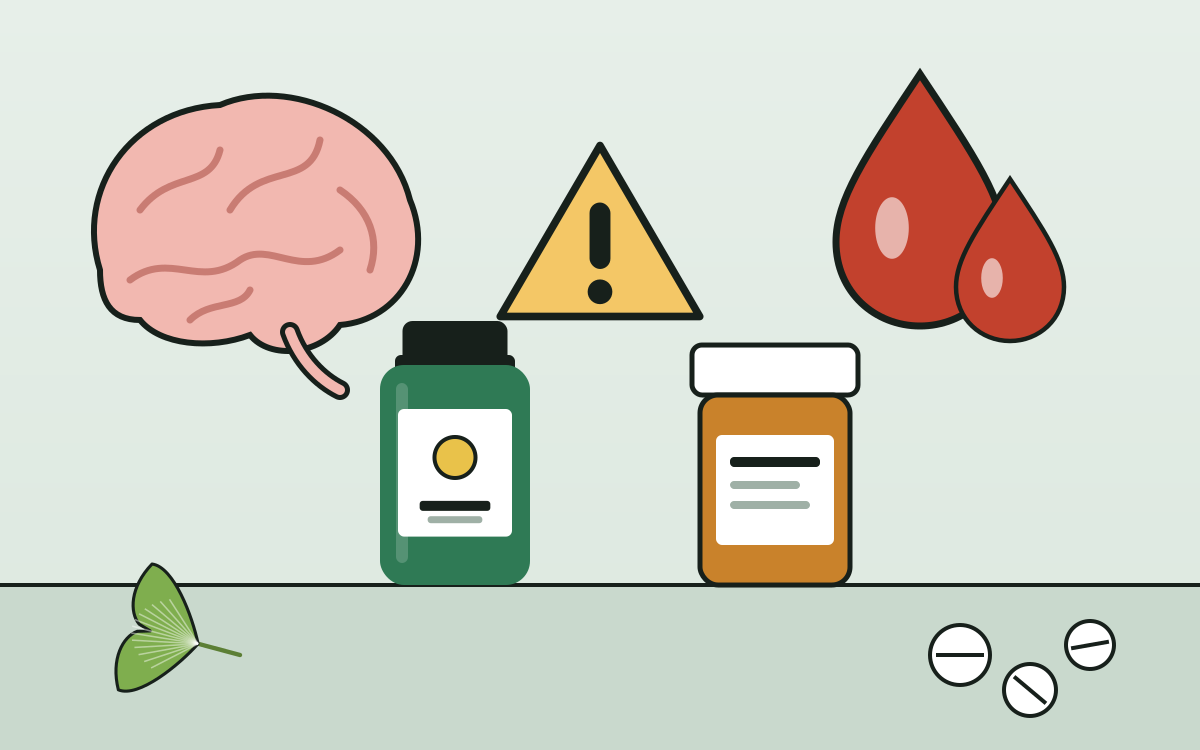
- if you bleed easily or take anticoagulants or antiplatelet medicines, use ginkgo only after talking to a doctor;
- stop ginkgo 3–4 days before surgery, or earlier if your surgeon asks;
- if you take warfarin, have your clotting checked when you start, change or stop ginkgo.
Seizures
In people with epilepsy, ginkgo may trigger further seizures, EMA warns. MSK describes seizures in predisposed people and in those taking medicines that lower the seizure threshold.
Drug interactions
- Warfarin, aspirin, clopidogrel, NSAIDs such as ibuprofen: possible extra bleeding.
- Dabigatran: ginkgo may raise its levels.
- Nifedipine: levels doubled in some people, causing dizziness and worse hot flushes.
- Efavirenz (an HIV medicine): ginkgo may lower its levels; the combination isn’t recommended.
Find your medicine or situation below:
Ginkgo and your medicines
Pick what you take to see what EMA and MSK say
What do you take?
What's known
Have your clotting checked
Studies with warfarin haven't shown an interaction, but spontaneous bleeding has been reported. EMA advises checking clotting when you start, change or stop ginkgo.
What to do: only after talking to your doctor
What's known
Possible extra bleeding
Bleeding in the eye, nose, brain and gut has been reported, at an unknown frequency.
What to do: only after talking to your doctor
What's known
Its levels may rise
Ginkgo may raise blood levels of dabigatran.
What to do: ask your GP or pharmacist
What's known
Levels doubled in some people
This came with dizziness and worse hot flushes.
What to do: ask your GP or pharmacist
What's known
The combination isn't recommended
Ginkgo may lower levels of this HIV medicine.
What's known
Risk of further seizures
EMA warns that ginkgo may trigger seizures in people with epilepsy. MSK describes seizures in people taking medicines that lower the seizure threshold.
Don't take it without your neurologist's agreement.
What's known
Stop in good time
EMA advises stopping 3–4 days before surgery, or earlier if your surgeon asks. Tell your dentist too.
Don’t take ginkgo if you’re pregnant: EMA lists pregnancy as a contraindication. It’s not recommended while breastfeeding or for children. MSK also mentions cases of low blood sodium and liver tumours in animals given high doses; what that means for people is unclear.
Check your supplements and medicines in our vitamin compatibility chart, and tell your doctor and dentist about ginkgo before any procedure.
Other ways to support your memory
If your memory has clearly got worse, see your GP first. One cause that a blood test can pick up is a lack of vitamin B12. Start with the basics: sleep, regular activity and having your blood pressure checked.
More supplements in this area are in our brain and memory section. If you’re curious about mushrooms, read about lion’s mane, and for the “anti-ageing” trend see NAD+ and NMN. Not sure where to start? Try our vitamin check.
How to choose ginkgo biloba on iHerb
- Check your medicines first: anticoagulants, antiplatelets, NSAIDs, epilepsy medicines, efavirenz, nifedipine, dabigatran.
- Choose a standardised leaf extract: 24% flavone glycosides and 6% terpene lactones.
- A stated ginkgolic acid limit (no more than 5 ppm) is a good sign.
- Aim for 120 mg per capsule and no more than 240 mg a day.
- Pick a single-ingredient product rather than a “brain” blend.
- Prefer products with independent quality testing (USP, NSF or similar seals). Our guide to supplement labels explains how to read the panel.
Bottom line: what to choose
Your GP agrees and you take no medicines
Standardised extract, 120 mg
24% flavone glycosides and 6% terpene lactones on the label
Ginkgo on iHerbYou rarely eat oily fish
Omega-3 fish oil
Check how much fish you actually eat first
Omega-3 on iHerbButtons lead to selections of the right form on iHerb. These are affiliate links; your price doesn't change.
FAQ
What are the benefits of ginkgo biloba?
It’s mostly taken for memory and concentration, and sometimes for tinnitus or circulation. In two large trials ginkgo didn’t lower the risk of dementia in older people. There’s no convincing evidence that it improves memory in healthy people or eases tinnitus.
What are the side effects of ginkgo biloba?
Headache is the most common, followed by dizziness, diarrhoea, stomach pain, nausea and vomiting. Bleeding in the eye, nose, brain or gut has been reported, and allergic reactions can occur. In people with epilepsy, ginkgo may trigger seizures.
Does ginkgo help with memory?
Not in a way that trials can reliably show. In the GEM trial of 3,069 people aged 75 and over, dementia was no less common with ginkgo than with placebo. For mild dementia, results are mixed: a Cochrane review called them inconsistent and unreliable.
Can I take ginkgo with aspirin or warfarin?
Only if your doctor agrees. EMA says ginkgo may change the effect of anticoagulants and antiplatelet medicines. Studies with warfarin haven’t shown an interaction, but EMA advises monitoring clotting when you start, change or stop ginkgo. Cases of spontaneous bleeding have been reported.
How much ginkgo should I take?
For medicines containing dry extract, EMA gives 240 mg a day in one or two doses, for at least 8 weeks. If there’s no improvement after 3 months, review it with your doctor. The large trials used 120 mg twice a day.
Does ginkgo help tinnitus?
Probably not. A 2022 Cochrane review of 12 trials with 1,915 people concluded that ginkgo may have little or no effect on tinnitus severity, though the evidence is very uncertain. NCCIH also says it doesn’t seem to relieve tinnitus.
Sources
- NCCIH. Ginkgo: Usefulness and Safety
- DeKosky ST et al. Ginkgo biloba for prevention of dementia: a randomized controlled trial (GEM). JAMA, 2008
- Vellas B et al. Long-term use of standardised Ginkgo biloba extract for the prevention of Alzheimer's disease (GuidAge). Lancet Neurol, 2012
- Birks J, Grimley Evans J. Ginkgo biloba for cognitive impairment and dementia. Cochrane Database Syst Rev, 2009
- Sereda M et al. Ginkgo biloba for tinnitus. Cochrane Database Syst Rev, 2022
- EMA/HMPC. European Union herbal monograph on Ginkgo biloba L., folium (2015)
- Memorial Sloan Kettering Cancer Center. Ginkgo – About Herbs
Ginkgo biloba at a glance
Based on NCCIH, EMA and Cochrane reviews
- What it is
- extract of the leaves of the Ginkgo biloba tree
- Preventing dementia
- doesn't work: GEM and GuidAge trials
- Tinnitus
- unlikely to help; weak evidence
- EMA dose
- 240 mg dry extract a day, for at least 8 weeks
- Main risks
- bleeding, seizures in people with epilepsy
- Avoid
- in pregnancy; with blood thinners only if your doctor agrees
Ginkgo doesn't treat dementia. If your memory is getting worse, see your GP so the cause can be found.
Shop ginkgo on iHerbNot with blood thinners or epilepsy unless your doctor agrees