Best omega-3 supplement in the UK: how much omega-3 per day, EPA and DHA, and which form to choose
This article contains affiliate links to iHerb. If you buy through them, we earn a commission at no extra cost to you. It doesn't affect which forms we recommend. Learn more
The bottle says "Fish Oil 1000 mg", but that's the weight of all the oil. The EPA and DHA in a capsule like that is often around 300 mg. Below: which numbers to read, how the forms differ, and when the NHS fish advice makes a supplement unnecessary.
What omega-3 does: EPA and DHA
Omega-3s are a family of fatty acids. Two matter most: EPA (eicosapentaenoic acid) and DHA (docosahexaenoic acid). DHA is part of the cell membranes in the brain and retina. Together, EPA and DHA affect blood triglycerides and inflammation.
A third omega-3, ALA, comes from flaxseed, chia and walnuts. Your body converts it to EPA and DHA poorly, at under 15%, and very little ends up as DHA. That’s why flaxseed oil can’t replace fish.

Do you need an omega-3 supplement?
Maybe not. NHS advice is at least two portions of fish a week, one of them oily, such as salmon, mackerel, herring, sardines or trout. A portion is about 140 g. If you eat that, you probably don’t need a supplement.
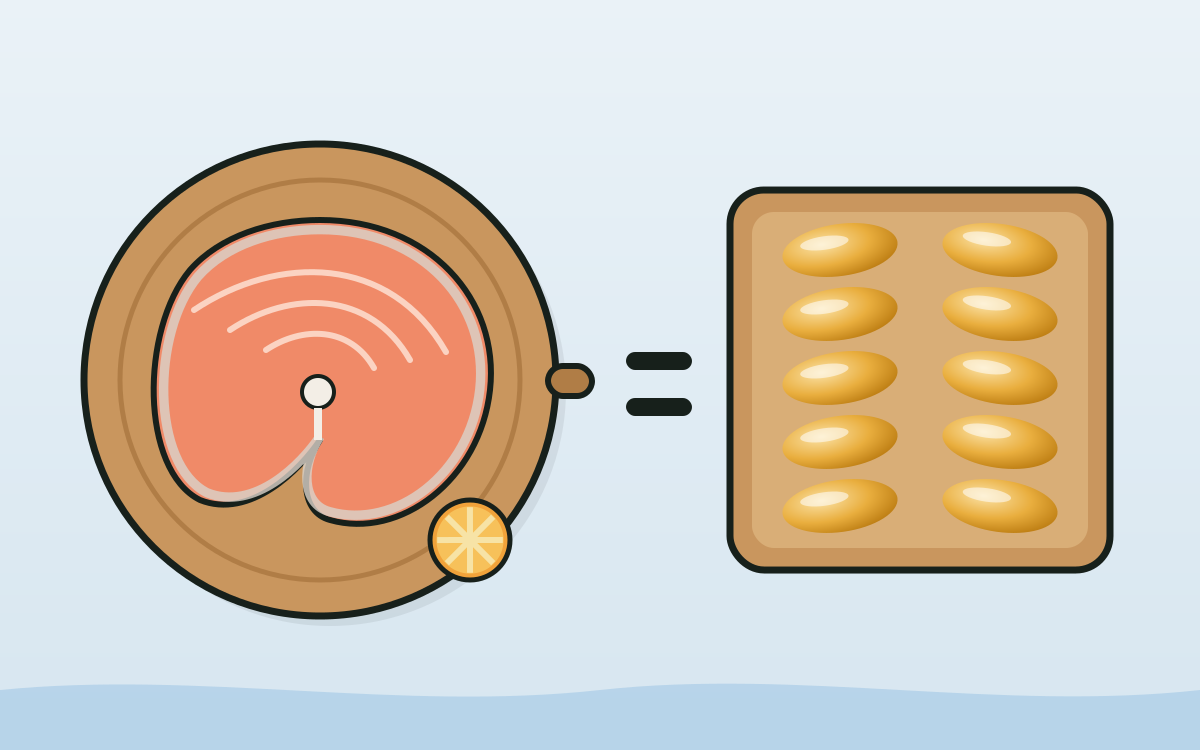
A single portion of salmon or herring gives about 3 g of EPA+DHA. That’s more than EFSA’s 250 mg a day for a whole week. A standard fish oil softgel gives about 0.3 g.
Limits on oily fish apply to some groups. Women who are pregnant, breastfeeding or may become pregnant should have no more than two portions a week. A supplement makes sense if:
- You rarely or never eat oily fish.
- You’re vegetarian or vegan (choose algae oil).
- A doctor has advised it, for example for high triglycerides.
How much omega-3 per day, and the “1,000 mg” trap
The big “Fish Oil 1000 mg” on the front catches plenty of people out. It’s the weight of all the oil in the capsule, and omega-3s are only part of it. Find the EPA and DHA lines on the label and add them up.
| On the bottle | EPA+DHA per capsule | Capsules for 500 mg |
|---|---|---|
| Fish Oil 1000 mg (standard) | about 300 mg | 2 |
| Omega-3 concentrate | 600–700 mg | 1 |
| High concentration | 800–1,000 mg | 1 |
Watch the serving size. If the panel says “Serving size: 2 softgels”, the EPA+DHA figure is for two capsules. Compare the price per gram of EPA+DHA, not per capsule. To work out how many fish oil capsules a day your bottle needs, use our omega-3 dose calculator.
Fish oil forms: triglyceride vs ethyl ester, krill and algae
- Triglycerides (TG) and re-esterified triglycerides (rTG). The natural form of dietary fat. rTG concentrates pack a lot of omega-3 into a capsule and are well absorbed.
- Ethyl esters (EE). A form created during concentration. Cheaper, and slightly less well absorbed. Any form raises blood EPA and DHA, especially with a fatty meal.
- Phospholipids (krill oil). Absorption may be similar or slightly better, but a capsule typically holds only 100–250 mg of EPA+DHA, so the price per gram is high.
- Microalgae oil. A source of DHA, sometimes EPA too, for vegans and vegetarians. Fish get their omega-3s from algae in the first place.
If the label doesn’t state the form, it’s usually ethyl esters or standard triglycerides. Tap through a sample panel to see how the form, source and serving appear on a bottle:
A fish oil label: tap a line
A sample panel for a standard "Fish Oil 1000 mg" softgel. Each line explains what to check
Supplement Facts
What it means
A serving is two capsules
Every figure below is for two softgels. Halve it to see what one gives you.
What it means
The weight of all the oil
2,000 mg is the oil in two 1,000 mg softgels. Omega-3s are only part of that oil.
What it means
The line that matters
A standard 1,000 mg softgel holds about 300 mg of EPA+DHA. For prevention, 250–500 mg a day is enough, so two of these do the job.
What it means
The form
TG and rTG are the natural form of dietary fat. Ethyl esters (EE) are cheaper and slightly less well absorbed, but any form works with a fatty meal.
What it means
Which fish
Ordinary fish oil. If this says cod liver oil, it's high in vitamin A: the NHS advises avoiding fish liver oil in pregnancy unless your GP says otherwise.
What it means
Storage
Omega-3s oxidise easily. A strong fishy smell when you open the bottle is a reason to return it. Enteric-coated softgels cause fewer fishy burps.
Freshness and purity
Omega-3s oxidise easily. Rancid fish oil causes unpleasant burps and may lose its benefit.
- Look for independent certification: IFOS (tests oxidation, heavy metals and omega-3 content), USP or NSF.
- A strong fishy smell when you open the bottle is a reason to return it.
- Store unopened bottles somewhere cool and dark. Once opened, follow the label, which often means the fridge.
- Enteric-coated capsules reduce fishy burps.
Fish oil and the heart: what trials show
The evidence is mixed. Don’t overrate the supplement.
- In the VITAL trial, 1 g of omega-3 a day in people without heart disease did not lower the overall risk of major cardiovascular events.
- High prescription doses (several grams a day in drug form) lower triglycerides. Doctors use them in people at high cardiovascular risk.
- A 2021 meta-analysis linked omega-3 supplements to a small rise in atrial fibrillation risk, higher above 1 g a day. Most participants were older people with heart disease or at risk of it.
If you don’t eat fish, 250–500 mg of EPA+DHA a day is a sensible substitute. Save high doses “for the heart” for when a doctor prescribes them.
Fish oil side effects and who should be careful
- Blood thinners (warfarin, clopidogrel and others). Studies of 3–6 g a day didn’t show a major effect on warfarin, but INR checks are advised with high doses. Tell your GP or anticoagulation clinic.
- Heart rhythm problems. Talk to your cardiologist first.
- Fish or seafood allergy. Choose algae oil. A shellfish allergy rules out krill oil.
- Pregnancy. The NHS advises avoiding fish liver oil supplements unless your GP recommends them, because they contain a lot of vitamin A. Ask your midwife before taking any omega-3 supplement.
- Before surgery, doctors sometimes ask you to stop high-dose omega-3.
EFSA advises an extra 100–200 mg of DHA a day in pregnancy, on top of the usual 250 mg of EPA+DHA. Oily fish, within the NHS limit of two portions a week, is the simplest way to get it.
How to choose the best omega-3 supplement in the UK
- Add up EPA and DHA per serving. For prevention, 250–500 mg is enough.
- Work out the price per gram of EPA+DHA, which is fairer than the price per bottle.
- Prefer TG or rTG, or take any form with a fatty meal.
- Look for IFOS, USP or NSF. Vegans should choose algae oil.
- Compare makers in our supplement brands section rather than trusting “1000 mg” on the front.
More on reading the panel in our label guide. For another popular “energy” supplement, see our guide to vitamin B complex.
Bottom line: what to choose
You rarely eat oily fish
Triglyceride-form omega-3 concentrate
250–500 mg EPA+DHA a day, with food
Omega-3 on iHerbButtons lead to selections of the right form on iHerb. These are affiliate links; your price doesn't change.
FAQ
How much omega-3 do I need a day?
EFSA considers 250 mg of EPA+DHA a day enough for adults. That’s roughly what one or two portions of oily fish a week provide. Higher doses of 1–4 g are used only on medical advice, for example for high triglycerides.
What is the best omega-3 supplement in the UK?
There’s no single best brand. The best product for you lists EPA and DHA clearly, gives 250–500 mg per serving, uses the triglyceride form and carries independent testing such as IFOS. Vegans should choose algae oil.
Fish oil or krill oil: which is better?
In krill oil, omega-3s are bound to phospholipids. Some studies suggest slightly better absorption, others don’t. Krill capsules usually contain little EPA and DHA and cost far more per milligram, so triglyceride fish oil is better value for most people.
What are the side effects of fish oil?
The most common are fishy burps, an aftertaste, heartburn and loose stools. They usually ease when you take it with food. In trials of higher doses, omega-3 was linked to a small rise in atrial fibrillation risk.
How can I tell if fish oil has gone rancid?
A strong fishy smell when you open the bottle, or fishy burps, are signs of oxidation. Good brands publish oxidation results (TOTOX) or carry IFOS certification. Keep the bottle closed and cool.
Can I take cod liver oil instead of regular fish oil?
You can, but cod liver oil is high in vitamin A. Count it with your other sources. The NHS advises avoiding fish liver oil supplements when you’re pregnant or trying for a baby, unless your GP says otherwise.
Sources
- NHS. Fish and shellfish
- NIH ODS. Omega-3 Fatty Acids – Fact Sheet for Health Professionals
- EFSA. Scientific Opinion on the Tolerable Upper Intake Level of EPA, DHA and DPA (2012)
- Gencer B et al. Effect of Long-Term Marine ω-3 Fatty Acids Supplementation on the Risk of Atrial Fibrillation in Randomized Controlled Trials of Cardiovascular Outcomes: A Systematic Review and Meta-Analysis. Circulation, 2021
- Manson JE et al. Marine n-3 Fatty Acids and Prevention of Cardiovascular Disease and Cancer (VITAL). N Engl J Med, 2019
Omega-3 at a glance
EPA and DHA for adults, based on NHS, EFSA and NIH ODS
- NHS advice
- 2 portions of fish a week, 1 of them oily (140 g)
- Usual need
- 250 mg EPA+DHA a day (EFSA)
- Look at
- EPA+DHA per serving, not "1,000 mg"
- Safe up to
- about 5 g EPA+DHA a day (EFSA)
- Vegan source
- microalgae oil
- Caution
- blood thinners; heart rhythm problems; fish liver oil in pregnancy
One portion of oily fish a week is the best source. A supplement helps if you rarely eat fish.
Shop omega-3 on iHerbCompare price per gram of EPA+DHA
Contents
- What omega-3 does: EPA and DHA
- Do you need an omega-3 supplement?
- How much omega-3 per day, and the “1,000 mg” trap
- Fish oil forms: triglyceride vs ethyl ester, krill and algae
- Freshness and purity
- Fish oil and the heart: what trials show
- Fish oil side effects and who should be careful
- How to choose the best omega-3 supplement in the UK