How to read a supplement label: the Supplement Facts panel explained
Almost every supplement on iHerb is American and carries a Supplement Facts panel. Five minutes with this panel and you'll stop overpaying for big bottles with small doses, or going over a safe upper limit by accident.
How the Supplement Facts panel is laid out
Every supplement sold in the US must carry a Supplement Facts panel. At the top are the serving size and the number of servings. Below is a list of ingredients with the amount per serving and the percentage of the daily value. Other ingredients follow in small print underneath.
A box from a high-street chemist in the UK looks different. It shows a table of nutrients per daily dose with % NRV (nutrient reference value). The logic is the same: find the amount of active ingredient in one dose. Tap a line on the interactive label to see what it means.
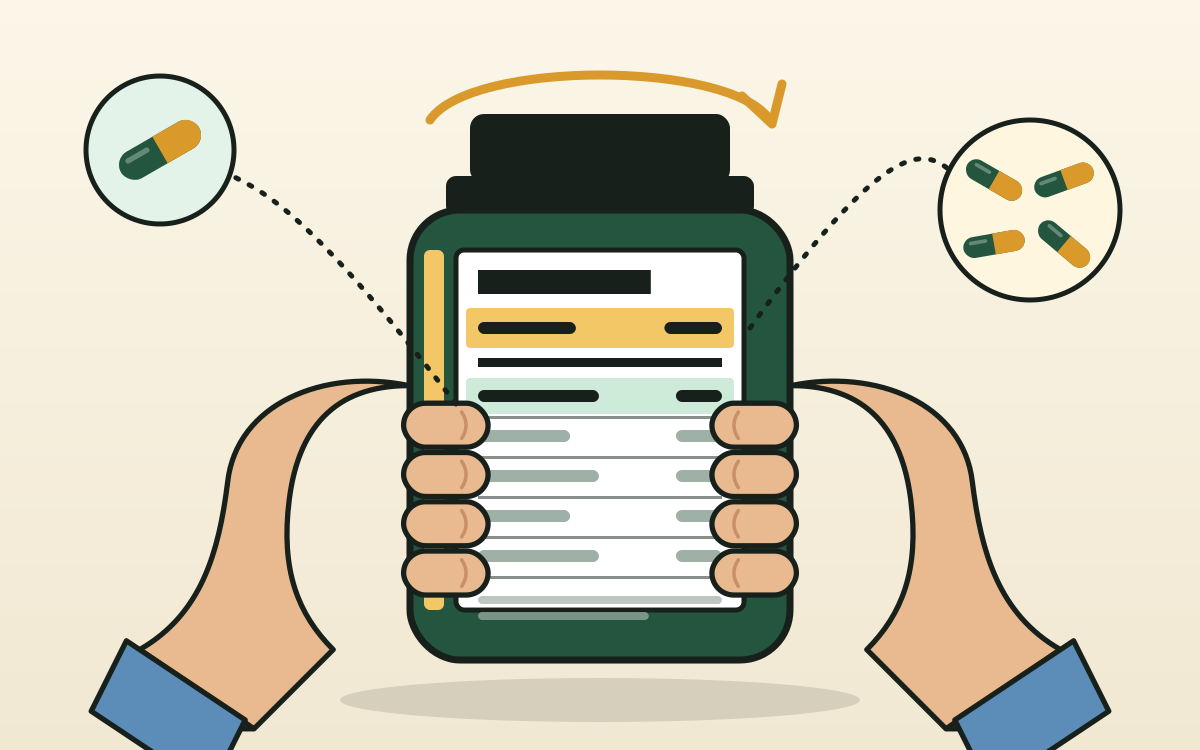
Interactive label: tap a line
A sample Supplement Facts panel for magnesium. Each line explains what to look for
Supplement Facts
What it means
Serving size
Every number below is for 2 capsules, not one. This is the most common trap: "400 mg" on the front may be a 2–4 capsule dose.
What it means
Servings per container
120 capsules at 2 per serving is 60 servings. Divide the bottle price by servings to get the price per day.
What it means
Amount per serving and % DV
% DV is the share of the US daily value. Over 100% isn't always bad, but for D3, zinc, B6, vitamin A and iron, check the upper limit.
What it means
Elemental amount and form
200 mg is the magnesium itself. The form follows "as". If the product name says "glycinate 1000 mg", that's the compound weight, not the magnesium.
What it means
Hidden extras
Some "plain" magnesium products add B6. 10 mg is the NHS maximum from supplements and nearly all of EFSA's 12 mg limit, so count it with your other vitamins.
What it means
Proprietary blend
The total weight of a mix without each ingredient's share. You can't tell the dose – for key nutrients, choose fully disclosed formulas.
What it means
Other ingredients
Capsule shell and fillers. Look here for allergens (soy, fish, gluten) and vegan labels.
Serving Size: the most important line
Serving Size is how many capsules, tablets or grams of powder make up one serving. Every number in the panel refers to that serving, not to a single capsule.
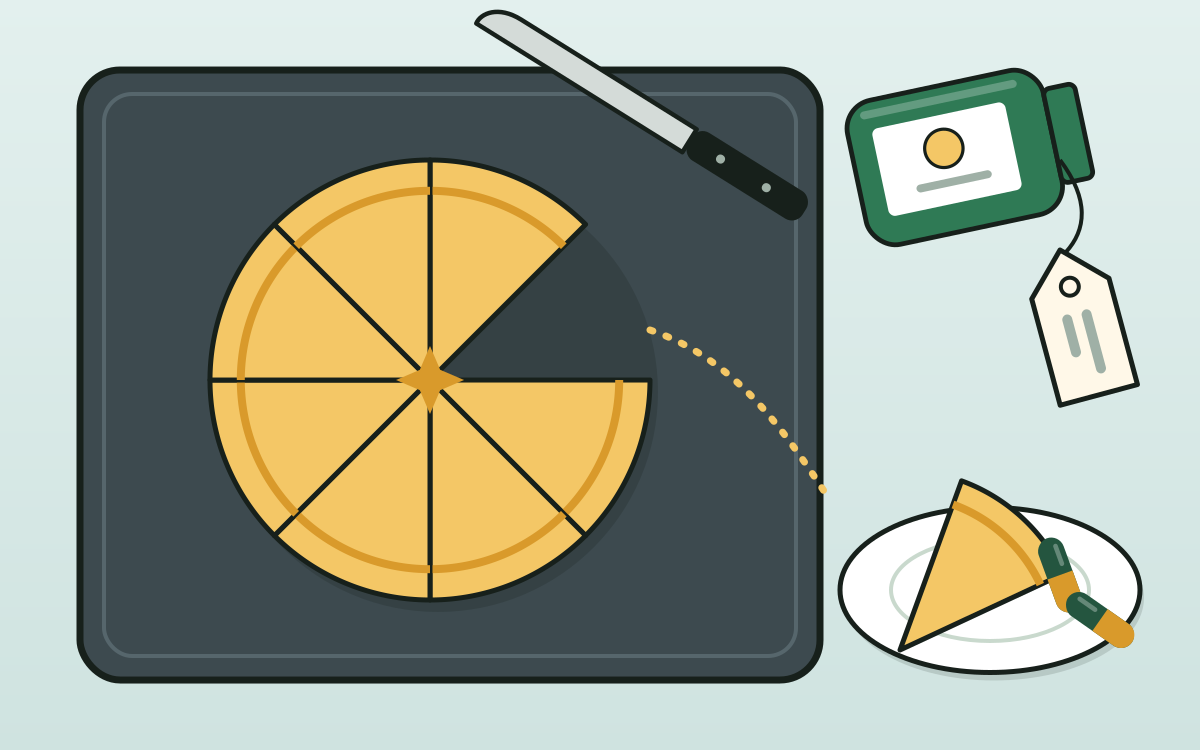
A typical case: the front of the bottle says “Magnesium 400 mg” in large print, but the panel says “Serving Size: 4 capsules”. So each capsule contains 100 mg of magnesium, and a 120-capsule bottle lasts 30 servings, not 120.
Amount Per Serving and the form in brackets
The amount is given for the elemental nutrient, and the form follows “as” in brackets:
Magnesium (as magnesium bisglycinate chelate) – 200 mg
That’s 200 mg of magnesium itself. A product called “Magnesium Glycinate 1000 mg”, on the other hand, may show the weight of the whole compound, of which only about 14% is magnesium. More on forms in our guides to magnesium and zinc.
Units
The table lists the units you’ll see most often on American labels.
| Unit | Meaning | Used for |
|---|---|---|
| mg | milligram (1/1,000 g) | minerals, vitamin C |
| mcg (µg) | microgram (1/1,000 mg) | vitamins D, B12, folate, biotin |
| IU | international unit | vitamins D, E, sometimes A |
| mcg DFE | dietary folate equivalents | folate; 1 mcg folic acid with food ≈ 1.7 mcg DFE |
| mg NE | niacin equivalents | niacin (B3) |
| mcg RAE | retinol activity equivalents | vitamin A |
For vitamin D, 1 mcg = 40 IU. So “125 mcg (5,000 IU)” is 5,000 IU, above the 100 mcg (4,000 IU) daily maximum set by the NHS and EFSA. For other vitamins, use our IU to mcg converter; doses of D3 are covered in our vitamin D3 guide.
% Daily Value and % NRV
% DV is the share of the US daily value. An asterisk () means no daily value has been set for that nutrient. UK and EU labels use % NRV* instead.
A figure above 100% isn’t dangerous by itself. For nutrients with low upper limits, though, check the dose against safe limits:
- Vitamin D: no more than 100 mcg (4,000 IU) a day, NHS and EFSA.
- Zinc: up to 25 mg a day from food and supplements, EFSA.
- Vitamin B6: no more than 10 mg a day from supplements, NHS.
- Vitamin A, iron and selenium: check the guide for each nutrient.
What a proprietary blend means
A Proprietary Blend line shows the total weight of a mix without the amount of each ingredient. For example, “Sleep Blend 500 mg: L-theanine, valerian, chamomile, lemon balm”. It could hold 400 mg of theanine or 10 mg, and the label won’t tell you which. When the dose matters to you, pick a product that lists every ingredient separately.
Other ingredients: what else is inside
Below the panel you’ll find the other ingredients: the capsule shell (gelatine or plant cellulose), fillers, colours and sweeteners. Look here for allergens (soy, fish, shellfish, gluten) and labels such as “vegan” or “non-GMO”. Small amounts of magnesium stearate and silicon dioxide are normal manufacturing aids and nothing to worry about.
Independent testing seals
The manufacturer fills in the Supplement Facts panel itself. Independent certification checks that what’s in the bottle matches the label:
- USP Verified checks identity, purity and dissolution;
- NSF Certified checks contents, and NSF Certified for Sport also screens for banned substances;
- IFOS covers omega-3: EPA/DHA content, oxidation and contaminants;
- Informed Sport and Informed Choice test for banned substances.

A product without a seal isn’t necessarily bad. A seal is simply one more assurance beyond the brand’s own word.
How to work out cost per dose
- Decide the dose you need (for example, 200 mg of magnesium a day).
- Use the panel to see how many capsules give that dose.
- Divide the capsules in the bottle by that number to get the number of days.
- Divide the bottle price by the number of days: that’s the cost per day.
Example: a 120-capsule bottle costs £18, and 2 capsules give 200 mg of magnesium. That’s 60 days, or £0.30 a day. A 180-capsule bottle costs £20, but you need 4 capsules for 200 mg. That’s 45 days, or £0.44 a day. The bigger bottle looks like the better deal, yet the first one is cheaper.
Put the numbers from your own bottle into the widget: price, capsule count and how many capsules give your dose. To compare several products side by side, use our cost-per-day calculator.
What one day's dose costs
Numbers from the bottle: price, capsule count and how many capsules give your dose
The example on this page: £18 for 120 capsules at 2 a day is £0.30 a day; £20 for 180 capsules at 4 a day is £0.44.
Expiry and storage
iHerb usually shows the expiry date on the product page. Omega-3, probiotics and liquid vitamins don’t like heat or light, so keep bottles closed and away from the radiator. Buy only what you’ll use before the date.
Once the label checks out, follow our step-by-step guide to ordering from iHerb.
FAQ
What does a % Daily Value over 100% mean?
That a serving contains more than the US daily value. That isn’t always bad: B12, for example, is only partly absorbed. But for vitamin D, zinc, B6, vitamin A and iron, check the dose against the UK and EU upper limits.
How is % Daily Value different from % NRV?
% Daily Value is the US measure. % NRV (nutrient reference value) is the one used on UK and EU labels. The reference amounts differ slightly, so the percentages for the same amount of a nutrient may not match.
How do I convert IU to mcg?
It depends on the vitamin. For vitamin D, 1 mcg equals 40 IU, so 1,000 IU is 25 mcg. Vitamins A and E use different factors, which our IU to mcg converter covers.
What is a proprietary blend?
A line labelled “Proprietary Blend” with the total weight of a mix but not the amount of each ingredient. It protects the brand’s formula, but you can’t tell how much of each active ingredient you’re getting. For single-purpose supplements, choose products with fully disclosed amounts.
Supplement Facts
The lines that matter
- Serving Size
- how many capsules make one serving
- Servings Per Container
- how many servings are in the bottle
- Amount Per Serving
- how much of each ingredient per serving
- % Daily Value
- share of the US daily value
- (as ...)
- the chemical form of the ingredient
- Other ingredients
- capsule shell, fillers, allergens
Compare prices for the same amount of active ingredient, not per bottle.