Supplements A–Z
Every vitamin, mineral and supplement we've covered, in one list. Each entry shows the daily need, the upper limit and a link to the full guide. Below: how to read the numbers and convert units.
A
-
Alpha lipoic acid
Energy and heart
- Daily need
- none set: your body makes it
- Doses in studies
- 600 mg a day by mouth; 300–600 mg by drip
-
Ashwagandha
Sleep and stress
- What it is
- the plant Withania somnifera; supplements mostly use root extract
- Studied for
- stress, anxiety, sleep; modest effect
-
Astaxanthin
Skin, hair and joints
- What it is
- a red carotenoid from the microalga Haematococcus pluvialis
- EFSA safe intake
- up to 8 mg a day from supplements
B
-
B vitamins
Energy and heart
- Who needs a B complex
- rarely: a limited or restricted diet
- More often needed alone
- B12 (vegans, over-50s) or folic acid
-
Berberine
Energy and heart
- What it is
- a plant compound from barberry, goldenseal and others
- Blood sugar
- modest drop in type 2 diabetes; inconsistent studies
C
-
Calcium and vitamin K2
Women's health
- Calcium a day
- 700 mg (NHS) / 1,000–1,200 mg (US)
- Upper limit
- 2,500 mg from all sources (EFSA); US 2,000 mg over 50
-
Children's vitamins
Immunity
- Main advice
- vitamin D for babies and young children
- Breastfed babies
- vitamin D from birth
-
Chlorophyll
Gut health
- What's in the bottle
- usually sodium copper chlorophyllin
- Doses in studies
- 100–300 mg a day in 3 doses
-
Chromium
Energy and heart
- Intake (US)
- 25–35 mcg; 20–30 mcg over 50
- EFSA position
- essential role not proven, no reference intake
-
Collagen
Skin, hair and joints
- Main types
- I and III – skin; II – cartilage
- Dose studied for skin
- 2.5–10 g peptides a day for 8–12 weeks
-
CoQ10
Energy and heart
- Daily need
- none set: your body makes CoQ10 itself
- Doses in studies
- 100–300 mg a day, sometimes up to 600 mg
-
Creatine
Men's health and sport
- Form
- creatine monohydrate
- Daily dose
- 3–5 g a day
D
-
Digestive enzymes
Gut health
- Authorised claim (UK/EU)
- lactase only, 4,500 FCC or more with food
- Alpha-galactosidase
- less wind after beans in small trials
E
-
Elderberry
Immunity
- What it is
- berries of the black elder (Sambucus nigra)
- Colds
- may be shorter and milder; uncertain evidence
-
Electrolytes
Men's health and sport
- Workout of about an hour
- water and food are usually enough
- Long sessions, heat
- electrolytes plus carbohydrate; drink to thirst
F
-
Ferritin
Tests and deficiencies
- What it shows
- your body's iron stores
- Iron deficiency
- below 15 µg/L (WHO)
-
Folic acid
Women's health
- Folate need
- 200 mcg a day (NHS)
- Trying to conceive
- 400 mcg a day: ideally 3 months before conception to week 12
G
-
Ginkgo biloba
Brain and memory
- What it is
- extract of the leaves of the Ginkgo biloba tree
- Preventing dementia
- doesn't work: GEM and GuidAge trials
-
Glucosamine and chondroitin
Skin, hair and joints
- Core treatment
- exercise and weight management (NICE)
- Glucosamine
- 1,500 mg a day; NICE advises against it
-
Glutathione
Skin, hair and joints
- Daily need
- none set: your body makes glutathione itself
- Doses in studies
- 250–1,000 mg a day by mouth
-
Glycine
Sleep and stress
- What it is
- a non-essential amino acid found in protein foods
- Dose in sleep studies
- 3 g before bed
H
-
Hair vitamins
Skin, hair and joints
- Normal shedding
- 50–100 hairs a day
- Common causes
- illness, stress, weight loss, low iron
I
L
-
L-arginine
Men's health and sport
- What it is
- an amino acid your body turns into nitric oxide
- From food
- about 3–5 g a day (Danish data)
-
L-carnitine
Men's health and sport
- What it is
- a compound that carries fat into mitochondria
- Where it comes from
- made by the body; found in red meat
-
L-theanine
Sleep and stress
- What it is
- an amino acid from tea leaves
- In a cup of green tea
- about 23 mg
-
Lecithin
Brain and memory
- What it is
- a mix of phospholipids from soya or sunflower
- Choline (EFSA)
- 400 mg a day; 480 mg in pregnancy, 520 mg when breastfeeding
-
Lion's mane
Brain and memory
- What it is
- the edible mushroom Hericium erinaceus
- Studied for
- memory, mood, stress; little data
-
Lutein
Skin, hair and joints
- Who benefits
- intermediate AMD, or late AMD in one eye
- Effect
- about 25% lower risk of late AMD
M
-
Maca root
Men's health and sport
- What it is
- an Andean root vegetable related to cabbage
- Libido
- limited evidence from a few small trials
-
Magnesium
Sleep and stress
- Daily need (NHS)
- 300 mg for men, 270 mg for women
- Limit from supplements
- 250 mg (EFSA); 350 mg (US)
-
Magnesium B6
Sleep and stress
- B6 per tablet
- usually 5 or 10 mg
- NHS advice on B6
- no more than 10 mg a day from supplements
-
Magnesium citrate
Sleep and stress
- Magnesium share
- about 11–16% of the compound's weight
- Typical dose
- 100–200 mg elemental magnesium a day
-
Magnesium deficiency
Tests and deficiencies
- Daily need
- 270 mg women, 300 mg men (NHS)
- Share in serum
- less than 1% of body magnesium
-
Magnesium glycinate
Sleep and stress
- What it is
- magnesium + glycine (bisglycinate)
- Magnesium share
- about 14% of the compound's weight
-
Men's supplements
Men's health and sport
- Almost everyone
- vitamin D 10 mcg in autumn and winter
- Zinc
- 9.5 mg a day; no more than 25 mg from supplements
-
Milk thistle
Gut health
- What it is
- a daisy-family plant; silymarin comes from its fruits
- Liver disease
- evidence conflicting or too limited
-
Multivitamins
Energy and heart
- Preventing disease
- not shown (USPSTF 2022; COSMOS)
- May help if
- limited diet, over 50, vegan, could get pregnant
N
-
NAC (N-acetylcysteine)
Immunity
- What it is
- acetylcysteine, a medicine ingredient
- Status
- supplement in the US; prescription-only medicine in the UK
-
NAD+ and NMN
Brain and memory
- What they are
- NAD+ is a cell coenzyme; NMN and NR are its precursors, forms of vitamin B3
- What's proven
- they raise blood NAD levels
O
-
Omega-3
Energy and heart
- NHS advice
- 2 portions of fish a week, 1 of them oily (140 g)
- Usual need
- 250 mg EPA+DHA a day (EFSA)
P
-
Pregnancy vitamins
Women's health
- Folic acid
- 400 mcg a day: ideally 3 months before conception to week 12
- Folic acid 5 mg
- only if your GP prescribes it
-
Probiotics
Gut health
- Check first
- the strain: genus, species and code
- Typical dose
- 1–10 billion CFU a day
-
Propolis
Immunity
- What it is
- a resin mix bees collect from tree buds and sap
- Best evidence
- lip balm for cold sores: trials of one extract
-
Psyllium husk
Gut health
- Fibre target
- 30 g a day (NHS)
- Typical UK intake
- about 20 g a day
Q
-
Quercetin
Immunity
- Daily need
- none set: it isn't a vitamin
- Doses in studies
- 150–1,000 mg a day
R
-
Reishi
Immunity
- What it is
- the mushroom Ganoderma lucidum (lingzhi)
- Sold for
- immunity, energy, cholesterol, blood pressure
-
Resveratrol
Energy and heart
- Daily need
- none set: it isn't a vitamin
- EFSA safe intake
- up to 150 mg trans-resveratrol a day
S
-
Seasonal vitamins
Immunity
- Autumn and winter
- vitamin D, 10 micrograms (400 IU) a day
- Spring
- vitamin D until late March or April
-
Selenium and iodine
Energy and heart
- Selenium need
- 70 mcg (EFSA); 60–75 mcg (UK)
- Selenium limit
- 255 mcg a day (EFSA, 2023), all sources
-
Skin supplements
Skin, hair and joints
- Most important
- sun protection: SPF 30+ and 4-star UVA
- Hyaluronic acid
- 120 mg a day; two small trials
-
Sleep supplements
Sleep and stress
- Melatonin in the UK
- prescription-only medicine (MHRA)
- Usual NHS prescription
- 2 mg slow-release, 1–2 hours before bed
-
Spirulina
Energy and heart
- What it is
- dried Arthrospira cyanobacteria
- Protein in 3 g
- about 1.7 g
T
-
Taurine
Energy and heart
- What it is
- an amino acid your body makes itself
- From food
- about 120–180 mg a day for meat eaters
-
Turmeric (curcumin)
Skin, hair and joints
- What it is
- the main active compound in turmeric
- Joints
- small drop in knee osteoarthritis pain; low-quality evidence
V
-
Vitamin B12
Energy and heart
- Daily need
- 1.5 mcg (NHS); 4 mcg (EFSA)
- Most likely to need it
- vegans, over-50s, metformin or PPI users
-
Vitamin C
Immunity
- Daily need
- 40 mg (NHS); 95–110 mg (EFSA)
- Upper limit
- 2,000 mg (US); EFSA set none
-
Vitamin D test
Tests and deficiencies
- What's measured
- 25(OH)D (calcidiol)
- Unit conversion
- ng/mL × 2.5 = nmol/L
-
Vitamin D3
Immunity
- Daily amount (NHS)
- 10 mcg (400 IU) for adults and children over 1
- When
- October to March for everyone; all year for some groups
-
Vitamins A and E
Skin, hair and joints
- Vitamin A need
- 600–700 mcg (NHS); 700–900 mcg (US)
- Vitamin A upper limit
- 3,000 mcg preformed vitamin A (EFSA, US)
W
-
Weight loss
Energy and heart
- The foundation
- a modest calorie deficit, activity and, where needed, treatment from your GP
- Best supplement effect
- about 1 kg more than placebo over months
-
Women's supplements
Women's health
- Almost everyone
- vitamin D in autumn and winter
- If you could get pregnant
- folic acid 400 mcg a day
Z
-
Zinc
Immunity
- Daily need (NHS)
- 9.5 mg for men, 7 mg for women
- Upper limit
- 25 mg (NHS, EFSA); 40 mg (US)
#
-
5-HTP
Sleep and stress
- What it is
- 5-hydroxytryptophan, the raw material for serotonin
- Source
- seed extract of Griffonia simplicifolia
How to use the A–Z
Supplements are sorted alphabetically. Each entry shows the two key numbers from its guide (usually the daily need and the upper limit) and the section it belongs to. Tap a name to open the full guide: forms, doses, who shouldn’t take it and interactions.

To find what you need quickly:
- Tap a letter in the row above the list.
- Search by the nutrient, not the brand: “Magnesium”, not a product name.
- If you’re starting from a goal rather than a nutrient, open supplements by goal.
- For an unfamiliar label term, see the supplement glossary.
Daily need, upper limit and the label figure
One nutrient can have four different numbers, and they’re easy to confuse.
- Daily need – what almost all healthy adults need a day from food and supplements together. In the UK this is the reference nutrient intake (RNI) the NHS quotes.
- Upper limit (UL) – the most you can take every day without harm. We use EFSA limits and give US limits second.
- % NRV – the share of the nutrient reference value printed on UK and EU labels.
- % DV – the US equivalent, found on most iHerb products. It’s often higher than the NRV.
Look at the Magnesium tab: the daily need is above the upper limit, and that’s not a mistake. EFSA’s 250 mg limit covers supplements only, while the need counts all food. Vitamin D is the opposite: the 100 mcg (4,000 IU) limit includes food and supplements.
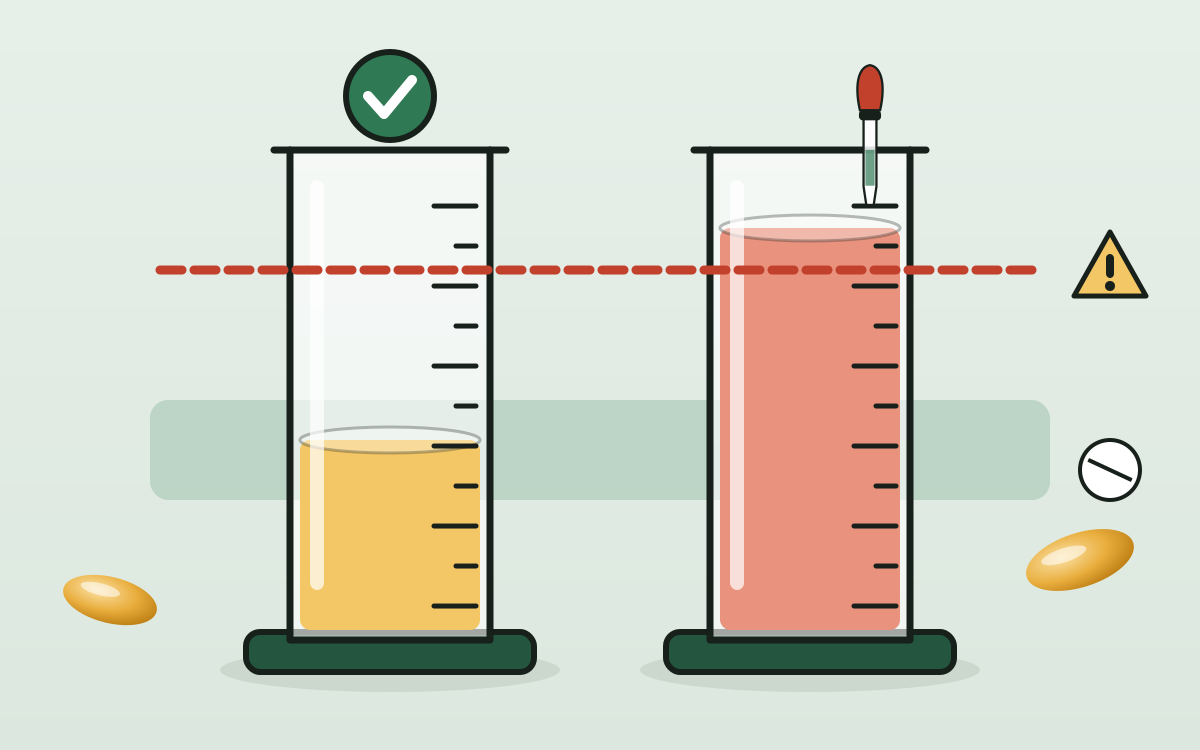
Units table: mg, mcg and IU
| Unit | What it is | Label example | How to convert |
|---|---|---|---|
| g | gram | creatine 5 g | 1 g = 1,000 mg |
| mg | milligram | magnesium 200 mg | 1 mg = 1,000 mcg |
| mcg (µg) | microgram | vitamin D 10 mcg, folic acid 400 mcg | 1 mcg = 0.001 mg |
| IU | unit of activity, not weight | vitamin D 400 IU | vitamin D: 1 mcg = 40 IU |
| mcg RAE | retinol activity equivalent (vitamin A) | 900 mcg RAE | 1 IU retinol = 0.3 mcg RAE |
| mg alpha-tocopherol | vitamin E | 15 mg | 1 IU natural = 0.67 mg; synthetic = 0.45 mg |
| mcg DFE | dietary folate equivalent | 400 mcg DFE | 1 mcg DFE = 0.6 mcg folic acid taken with food |
| CFU | live bacteria in a probiotic | 10 billion CFU | 1 × 10⁹ CFU = 1 billion |
| nmol/L and ng/mL | blood test units | 25(OH)D 50 nmol/L | 1 ng/mL = 2.5 nmol/L |
UK labs report vitamin D in nmol/L; US sources often use ng/mL. You can do the most common conversions from the table right here. For beta-carotene, use our separate IU to mcg converter, and the vitamin deficiency tests section explains how to read results.
Convert the units in the table
Pick what to convert and enter the number from the label or your test result
25 mcg
The unit is in the line below
1,000 → 25 mcg
Vitamin D: 1 mcg = 40 IU. EFSA's upper limit is 100 mcg (4,000 IU) a day from food and supplements together.
Factors from NIH ODS. Minerals aren't measured in IU.
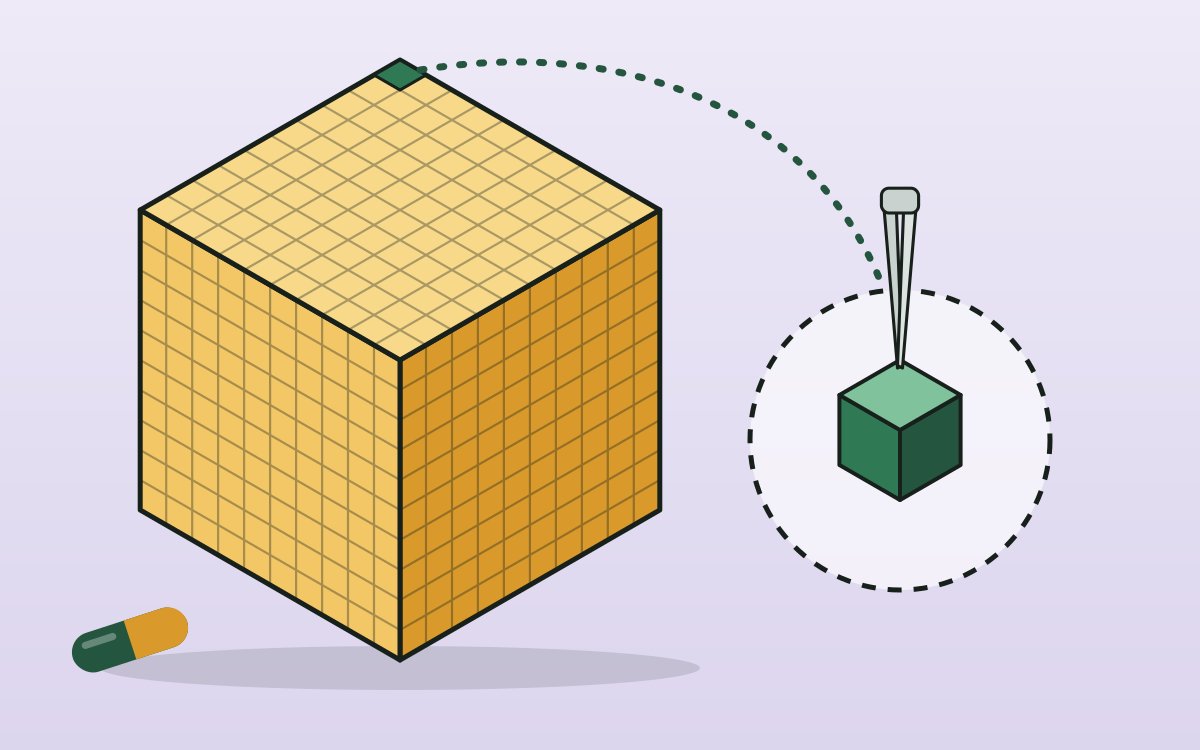
When the general figures don’t apply to you
The needs and limits here are for healthy adults. Talk to your GP or pharmacist about doses if:
- You’re pregnant or breastfeeding: folate and iron needs rise, and vitamin A (retinol) supplements should be avoided.
- You have kidney or liver disease.
- You take regular medicines, especially anticoagulants, levothyroxine or antibiotics.
- You’re choosing for a child: doses depend on age and weight.
How to use the A–Z when shopping on iHerb
- Open the nutrient’s entry and note the daily need and the upper limit.
- On the product page, find the Supplement Facts panel and the amount per serving.
- Check the unit: mg, mcg or IU. Convert if needed.
- Add the dose to your other supplements and food, and make sure you stay under the limit.
Our guide to supplement labels covers the panel line by line, and the types of magnesium guide shows how elemental amounts work.
FAQ
How do I convert IU to mcg?
Each vitamin has its own factor. Vitamin D: 1 mcg = 40 IU, so 400 IU = 10 mcg and 1,000 IU = 25 mcg. Vitamin A: 1 IU of retinol = 0.3 mcg RAE. Vitamin E: 1 IU of the natural form = 0.67 mg, of the synthetic form 0.45 mg. Minerals aren’t measured in IU.
What's the difference between % NRV and % DV?
Both show a dose as a share of a reference intake. UK and EU labels use NRV; US labels, which you’ll see on most iHerb products, use DV. 25 mcg of vitamin D is 500% NRV but 125% DV.
Why is the daily need for magnesium higher than its upper limit?
The NHS figure (270–300 mg) counts all food, while EFSA’s 250 mg limit applies only to magnesium from supplements and medicines. Magnesium in nuts, grains and greens doesn’t count towards it.
What's the difference between mcg and mg?
1 mg equals 1,000 mcg. Mixing them up matters: 400 mcg of folic acid is a normal dose, 400 mg is a thousand times more. Labels may write micrograms as mcg or µg.
Sources
- NHS. Vitamin D
- NHS. Others – vitamins and minerals (magnesium, zinc, selenium)
- NIH ODS. Vitamin A and Carotenoids – Fact Sheet for Health Professionals
- NIH ODS. Vitamin E – Fact Sheet for Health Professionals
- EFSA. Overview on Tolerable Upper Intake Levels (2024)
- Regulation (EU) 1169/2011, Annex XIII: nutrient reference values