How much omega-3 per day, and how many fish oil capsules is that?
This article contains affiliate links to iHerb. If you buy through them, we earn a commission at no extra cost to you. It doesn't affect which forms we recommend. Learn more
The front of the bottle says "Fish Oil 1,000 mg", but that's the weight of all the oil, not the omega-3. This calculator takes the EPA and DHA lines from the label and works out how many softgels give 250 mg and 500 mg a day.
What the omega-3 calculator works out
The calculator adds EPA and DHA (the two best-studied omega-3 fatty acids from fish) and divides the total by the number of softgels in a serving. That gives you the omega-3 in one softgel. It then works out how many softgels a day provide 250 mg and 500 mg of EPA+DHA.
The big number on the bottle, “1,000 mg” or “1,200 mg”, is usually the weight of all the fish oil. According to NIH ODS, a typical 1,000 mg softgel contains 180 mg of EPA and 120 mg of DHA, which is 300 mg of omega-3. Concentrates often have 500–700 mg or more. Without the maths, it’s easy to take half what you meant to, or twice as much.
How much omega-3 per day you need
| Situation | EPA+DHA a day | Who says so |
|---|---|---|
| Adults | 250 mg | EFSA |
| Pregnancy and breastfeeding | 250 mg plus 100–200 mg DHA | EFSA |
| Coronary heart disease | about 1 g, on medical advice | American Heart Association |
| Safe level from supplements | up to 5 g | EFSA |
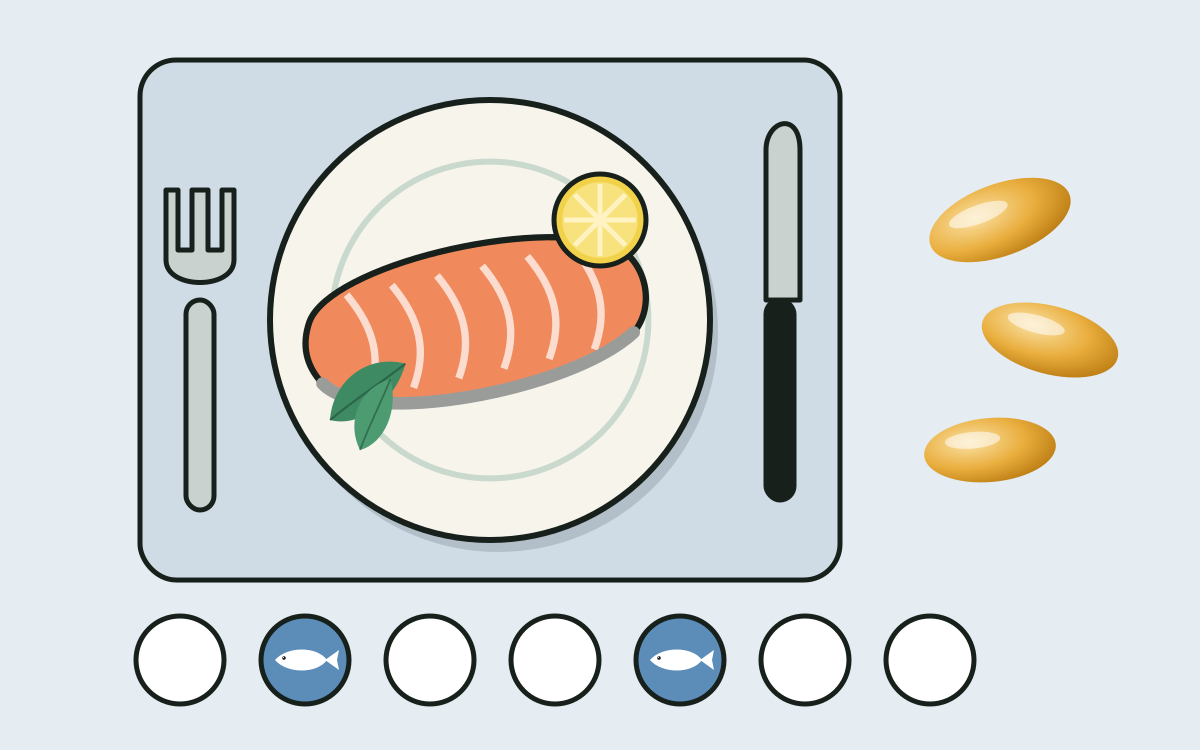
Food counts too. The NHS recommends at least 2 portions of fish a week (a portion is about 140 g), including 1 of oily fish such as salmon, mackerel, sardines, herring, pilchards or trout. Fresh and tinned tuna don’t count as oily. If you already eat like this, you may not need a supplement.
How to use the calculator
- Find the Supplement Facts panel on the bottle or product page.
- Enter the EPA (eicosapentaenoic acid) figure in milligrams in the first box.
- Enter the DHA (docosahexaenoic acid) figure in the second box.
- Check the serving size and enter how many softgels it covers. It’s often 2.
- Read the big number and the line below it: they give the softgels for 500 mg and for 250 mg.
How many omega-3 softgels a day
Copy EPA and DHA from your bottle's Supplement Facts panel, plus the serving size
2 softgels for 500 mg
Softgels a day for 500 mg of EPA+DHA
Each softgel has 300 mg EPA+DHA. For 250 mg take 1, for 500 mg take 2.
Standard concentration
Omega-3 concentrates on iHerbDefaults are a typical "Fish Oil 1000 mg" softgel.
How to read the result
The big number is how many softgels a day give 500 mg of EPA+DHA. The line underneath shows the omega-3 per softgel and the number needed for 250 mg.
| EPA+DHA per softgel | Calculator’s verdict | What it means |
|---|---|---|
| Under 300 mg | Weak concentrate | 2–4 softgels for 500 mg; a 600 mg+ concentrate is usually better value |
| 300–499 mg | Standard concentration | One or two softgels a day |
| 500 mg or more | High concentration | One softgel is enough |
Example: “Fish Oil 1,000 mg”, serving 1 softgel, EPA 180 mg, DHA 120 mg. Each softgel has 300 mg, so one covers 250 mg and two cover 500 mg. Another: serving 2 softgels, EPA 650 mg, DHA 450 mg. Each softgel has 550 mg, so one is enough.
If the label lines blur together, tap through them one by one:
Which label lines the calculator needs
A typical "Fish Oil 1,000 mg" softgel. Tap a line to see whether to enter it
Supplement Facts
What to do with this line
Serving size
One softgel here. If it says 2 Softgels, enter 2 in the "Softgels per serving" box and the calculator divides EPA and DHA for you.
What to do with this line
Amount per serving
Every figure below is for the whole serving, not for one softgel.
What to do with this line
Weight of the oil – skip it
This is all the fish oil. About a third of it is omega-3; the rest is other fats.
What to do with this line
Total omega-3 – skip it
It may include DPA and ALA. Enter it instead of EPA and DHA and the calculator will overestimate your dose.
What to do with this line
EPA – first box
Copy the figure as it is, in milligrams.
What to do with this line
DHA – second box
With EPA that's 300 mg per softgel: one covers 250 mg, two cover 500 mg.
How to take omega-3
- Take softgels with a meal: fishy burps, heartburn and nausea are less likely.
- Don’t take more than you need. 250–500 mg of EPA+DHA covers everyday needs; doses of 1 g or more are for medical use.
- The calculator won’t work for flaxseed oil: plant omega-3 (ALA) converts poorly to EPA and DHA.

Limits and when to see a doctor
- The calculator doesn’t count the fish you eat or set a treatment dose.
- High doses of omega-3 may increase bleeding with warfarin and other blood thinners. If you take one, check with your GP or pharmacist first.
- In the REDUCE-IT and STRENGTH trials, 4 g of omega-3 a day for several years slightly raised the risk of atrial fibrillation in people with, or at high risk of, heart disease.
- If you’re pregnant or trying for a baby, avoid cod liver oil and other fish liver oils: the NHS warns they’re high in vitamin A, which can harm the baby.
- If you’re allergic to fish, choose microalgae oil.
How to choose omega-3 on iHerb
- Decide on your dose: 250 mg or 500 mg of EPA+DHA a day.
- Open the Supplement Facts on the product page and enter EPA, DHA and serving size into the calculator.
- Compare two or three bottles by softgels a day and by cost per day.
- Between two similar bottles, pick the one with independent testing for oxidation and contaminants.
For triglyceride vs ethyl ester and fish oil vs krill, see how to choose fish oil. Our guide to reading a supplement label covers every line of the panel, and the zinc calculator and vitamin D sunlight calendar help with other supplements.
Bottom line: what to choose
You rarely eat oily fish
Omega-3 concentrate, 250–500 mg EPA+DHA
One or two softgels with food
Omega-3 on iHerbButtons lead to selections of the right form on iHerb. These are affiliate links; your price doesn't change.
FAQ
How many fish oil capsules should I take a day?
Enough to get 250–500 mg of EPA and DHA combined. If each capsule has 300 mg of EPA+DHA, one or two will do. If it has 150 mg, you’ll need two to four. Enter the figures from your bottle into the calculator for an exact answer.
How much omega-3 per day do I need?
EFSA considers 250 mg of EPA+DHA a day adequate for adults, plus 100–200 mg of DHA in pregnancy and breastfeeding. The NHS suggests at least two portions of fish a week, one of them oily. Doses of around 1 g or more are for medical use.
How much omega-3 is in 1,000 mg of fish oil?
Usually about 300 mg: 180 mg of EPA and 120 mg of DHA. The rest is other fats. Check the EPA and DHA lines on the Supplement Facts panel for exact figures.
Is it safe to take more than 1 g of omega-3 a day?
EFSA considers up to 5 g of EPA+DHA a day from supplements safe. But in large trials, 4 g a day for several years slightly raised the risk of atrial fibrillation in people with heart disease. Take high doses only on medical advice.
What if the label only shows Total Omega-3?
That line may include other fatty acids such as DPA and ALA. If you enter the total instead of EPA and DHA, the calculator will overestimate your dose. Choose a product that lists EPA and DHA separately.
Sources
Omega-3 dose at a glance
EPA and DHA for adults, based on EFSA, NHS and NIH ODS
- Adequate intake
- 250 mg EPA+DHA a day (EFSA)
- Pregnancy
- an extra 100–200 mg DHA
- From food (NHS)
- 2 portions of fish a week, 1 oily
- Safe from supplements
- up to 5 g EPA+DHA a day (EFSA)
- "1,000 mg" softgel
- usually 180 mg EPA + 120 mg DHA
- Caution
- blood thinners, high doses
If you eat oily fish every week, you may not need a supplement.
Shop omega-3 on iHerbCompare EPA plus DHA, not the "1,000 mg" on the front